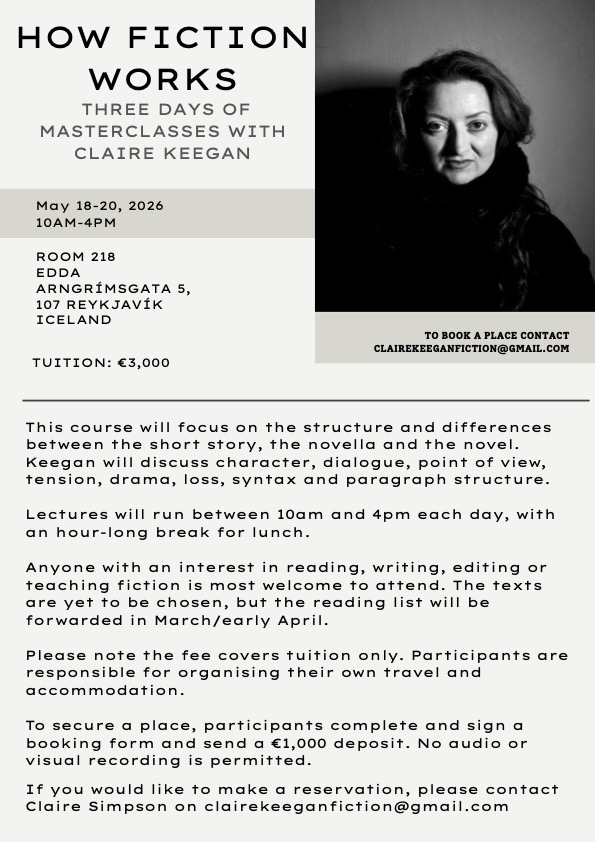
How Fiction Works: Three-day masterclass in Iceland

Dates: May 18-20, 2026. Time: 10am-4pm

Location: Edda building, Reykjavík, Iceland

Tuition: € 3,000

This course will focus on the structure and differences between the short story, the novella and the novel. Keegan will discuss character, dialogue, point of view, tension, drama, loss, syntax and paragraph structure.

Lectures will run between 10am and 4pm each day, with an hour-long break for lunch.

Anyone with an interest in reading, writing, editing or teaching fiction is most welcome to attend. The texts are yet to be chosen, but the reading list will be forwarded in March/early April. 

Please note the fee covers tuition only. Participants are responsible for organising their own travel and accommodation.

To secure a place, participants complete and sign a booking form and send a €1,000 deposit. No audio or visual recording is permitted.

If you’d like to make a reservation on this course, please email Claire Simpson on clairekeeganfiction@gmail.com

ABOUT CLAIRE KEEGAN

Claire Keegan’s works of fiction are critically acclaimed international bestsellers, translated into 35 languages.

Antarctica won the Rooney Prize for Irish Literature. Walk the Blue Fields received the Edge Hill Prize. Foster earned the Davy Byrnes Award.

Small Things Like These was shortlisted for the Booker Prize and the Rathbones Folio Prize, winning the Orwell Prize for Political Fiction and The Kerry Prize for Irish Novel of the Year.

So Late in the Day, first published in The New Yorker, was shortlisted for Book of the Year at the British Book Awards.

Keegan was named Woman of the Year for Literature in Ireland in 2022 and Author of the Year in Ireland for 2023.

In 2024 she was presented with the Markievicz Award from the Arts Council, and the Siegfried Lenz Award in Hamburg.

This year, Irish Times readers chose Small Things Like These as their Book of the Century, and The Sunday Times critics chose it as Irish Novel of the Century.
Online literature course from Professor Mary McCay

Dates: October 9 – November 27, 2025

Time: 7:30pm – 9:30pm GMT (1:30pm – 3:30pm CST)

Cost: €350

THIS EIGHT-WEEK COURSE WILL BE TAUGHT OVER ZOOM

Mary McCay was an English professor at Loyola University New Orleans where she taught American
Literature, Film, Travel Writing and Irish Literature. She was advisor and professor to internationally acclaimed author, Claire Keegan.

Over the years, Professor McCay has continued to teach. Her most recent course, which ran for eight weeks online was titled, Women and The Booker Prize.

For this course, Professor McCay has chosen texts written by women who have experienced upheaval in their lives because of worsening conditions in their countries. The impact of social and political events on the lives of the women themselves and on their families is chronicled across different time periods, social classes, races, and countries. Women often find their lives disrupted by external circumstances that result in life-changing experiences. The choices they are forced to make–personal, social, and political–often result in upheaval and uncertainty.

To book a place, please contact Carmel at carmelnicanultaigh@gmail.com

Week 1: Relentless, Wudasie Nayzgi
Week 2: Whereabouts, Jhumpa Lahiri
Week 3: Behind You Is the Sea, Susan Mauddi Darraj
Week 4: The Storm We Made, Vanessa Chan
Week 5: The Storm We Made, Vanessa Chan (continued)
Week 6: Catalina, Karla Cornejo Villavicencio
Week 7: Girl, Edna O’ Brien
Week 8: Looking At Women Looking At War, Victoria Amelina

Participants are responsible for sourcing and reading the texts prior to the beginning of the
course.

Beginnings, Middles, Endings: The Structure of a Narrative with Claire Keegan

image1

Goldsmiths University, London

November 2 & 3, 2019. 9:30am–5pm, both days

Claire Keegan, internationally acclaimed author and fiction-writing coach, will direct this, her most popular fiction writing course, using a novel and two short stories to demonstrate and explore the mechanics of fiction writing and narrative structure.

1. The Great Gatsby by F. Scott Fitzgerald

2. “Good Country People” by Flannery O’Connor

3. “Nobody Said Anything” by Raymond Carver

How do stories begin? How and why does an author make an incision in time and build tension? How is a reader drawn into a narrative? We will also explore the much-neglected middle; the trunk of the story, its denouement and turning points — and ask if endings are natural. Why do stories need to end, to find a place of rest? The discussion around endings will focus on falling action, emotional consequences and inevitability. Participants will also examine the differences between the short story and the novel.

This weekend will be of particular interest to those who write, teach, read or edit fiction — but anyone with an interest in how fiction works is welcome to attend.

To book your place, contact ckfictionclinic@yahoo.com Tuition is £350. A 50% deposit secures.

IMG_3242

Claire Keegan’s story collections include Antarctica, Walk the Blue Fields and Foster (Faber & Faber). These stories, translated into 17 languages, have won numerous awards. Her debut, Antarctica, was a Los Angeles Times Book of the Year. “These stories are among the finest stories recently written in English,” wrote the Observer. Walk the Blue Fields, her second collection, was Richard Ford’s Book of the Year in 2010, and won the Edge Hill Prize, awarded to the strongest collection published in the British Isles. Foster won the Davy Byrne’s Award, then the world’s richest prize for a single story. New Yorker readers chose Foster as their story of the year. It was also published in Best American Stories is now on the school syllabus in Ireland. Keegan has earned an international reputation as a teacher of fiction, having taught workshops on four continents.

Every line seems to be a lesson in the perfect deployment of both style and emotion.” Hilary Mantel

The best stories are so textured and so moving, so universal but utterly distinctive, that it’s easy to imagine readers savoring them many years from now and to imagine critics, far in the future, deploying new lofty terms to explain what it is that makes Keegan’s fiction work.” The New York Times

Every single word in the right place and pregnant with double meaning.” Jeffrey Eugenides, The New York Times

Keegan is a rarity, someone I will always want to read.” Richard Ford

The Short Story with Claire Keegan

The River Mill Writers’ Retreat, Co Down. April 13 & 14

10am–5pm, both days.

This weekend course will explore the short story using works from the anthology pictured below. Participants will be asked to consider:

  • How fiction works — and why it sometimes doesn’t

  • Where and when stories begin and how and if this differs from the novel

  • The differences between a short story and the novel / a chapter

  • Beginnings, Middles, Endings: Narrative Structure


Participants will, in the light of structure and the short story, be discussing the art form using the following stories: 

1. Sonny’s Blues by James Baldwin

2. A Distant Episode by Paul Bowles 

3. Reflections by Angela Carter 

4. Goodbye, My Brother by John Cheever 

5. Gooseberries by Anton Chekhov

6. The Daughters of the Late Colonel by Katherine Mansfield 

7. Labor Day Dinner by Alice Munro 

8. Spring in Fialta by Vladimir Nabokov 

9. The Flowers by Alice Walker


This course will be of particular interest to those who write, teach, read or edit fiction — but anyone with an interest in how fiction works is welcome to attend. To book your place, contact ckfictionclinic@yahoo.com Tuition is £300. A 50% deposit secures. The River Mill is now fully booked out but there are other local places to stay. Lunch, tea and coffee provided for all.

Claire Keegan has written Antarctica, Walk the Blue Fields and Foster (Faber & Faber). These stories, translated into 17 languages, have won numerous awards, been published in The New Yorker, Best American Stories, The Paris Review. Keegan has earned an international reputation as a teacher of fiction, having taught workshops on four continents.

The Child in Society: Weekend of Fiction Writing & Reading with Claire Keegan

Amber Springs Hotel, Gorey, Co Wexford

June 29 & 30, 2019

children

There can be no keener revelation of a society’s soul than the way in which it treats its children. Nelson Mandela

For two days, Claire Keegan, author of Foster (Faber & Faber) will explore fiction writing through the linked theme of The Child in Society. Discussion will include the rights of the child, having and not having children, fathering, mothering, fostering, adopting and neglecting children. Participants will be asked to imagine being a boy, a girl, a parent, a child minder – and undoubtedly there will be talk around housing, fathering, contraception, pregnancy, money, hunger, mothering, sleep and what it means to love and be loved, to mind and to be minded — from different points of view. The lecture will explore and display how time, tension, drama, dialogue and narrative structure are put to use in the following:

Jude the Obscure, a novel by Thomas Hardy

The River,” a story by Flannery O’Connor

Sleepyhead,” a story by Chekov, translated by Constance Garnett

The Widow’s Son,” by Mary Lavin.

Vera Drake, a film by Mike Leigh

Tuition 350 euro. Reservations can be made by emailing ckfictionclinic@yahoo.com